


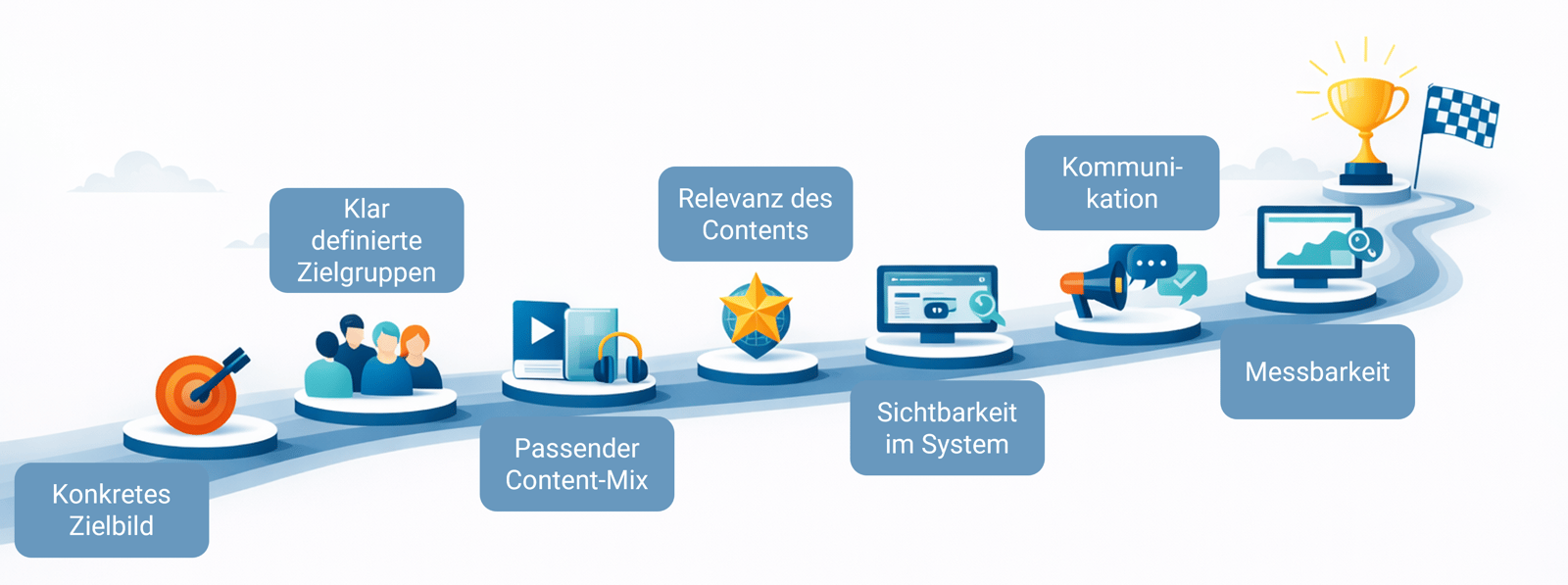
Why Does an LMS Need a Content Strategy?
A content strategy translates the learning offerings into concrete decisions. It determines which content is relevant for which target audience, in what format it is presented, and through which channel the next learning step takes place.
In short: An LMS without a content strategy is just a repository for courses. With a content strategy, it becomes a personalized guide.
Wide selection, little guidanceAn overwhelming number of courses, many different providers, and no personalized content recommendations. |
|
Control via AssignmentsVoluntary learning depends almost entirely on end users searching for content. |
|
Reporting Often Focuses Only on Completion RatesRare analyses of popular content or content that has a particularly lasting impact. |
The alliantis Approach in 7 Steps
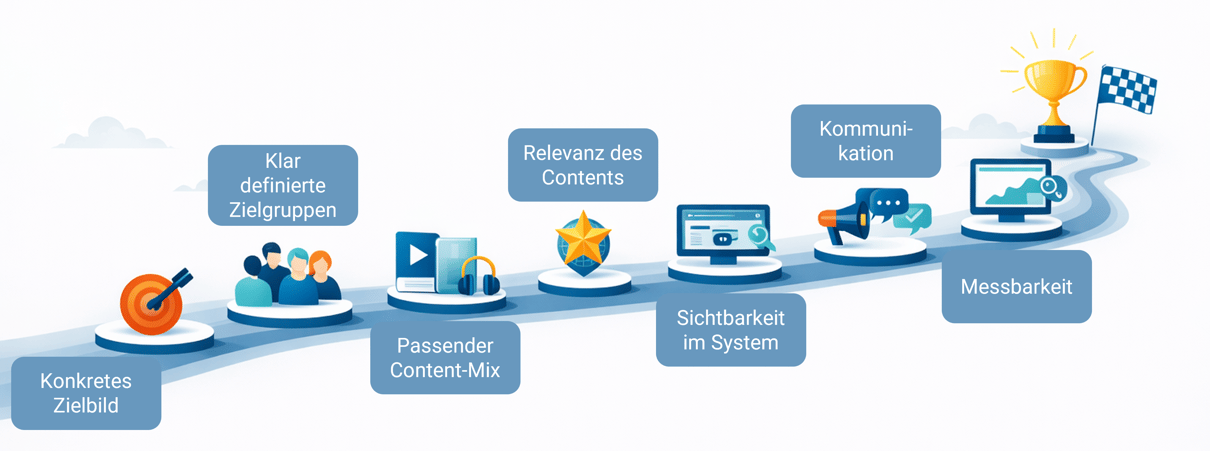
A successful content strategy isn’t created in a single step—it requires several building blocks that build on one another:
-
A concrete vision: What should the learning offering achieve?
-
Clearly defined target audiences: Who is the content curatedfor ?
- Appropriate content mix: Which formats are most effective?
- Content relevance: Which of the target audience’s pain points are being addressed?
- Visibility within the system: How will the curated content be positioned within the system?
- Communication: How will the target audiences learn about the offering?
- Measurability: How is the impact of the curated content measured?
Wondering where to start with your content strategy in the LMS?
Talk to our experts about your current situation and the key milestones for you.
Our Guiding Principles for Curation
The following principles have proven effective in practice:
Relevance over completenessA good selection is more valuable than a complete catalog. |
|
Target Audience Over TopicFirst ask: Who is this relevant to? Then: What is the topic? |
|
Curation over new contentUse existing content first, then fill in the gaps. |
|
Small collections instead of large librariesCurated offerings must be manageable and enable decision-making. |
|
Measurement as a learning loopKPIs determine what gets improved, not just what gets reported. |
|
Maintenance is part of the strategyPlaylists and recommendations require fixed review cycles. |
Conclusion: Personalization over a catalog
An LMS only becomes effective when employees find the right learning path for their own professional development and learning becomes an integral part of their daily work.
A content strategy ensures this: It defines target audiences, curates content based on relevance, makes offerings visible in various places, communicates them, and measures their impact.
How this works in practice is shown on our pages on Cornerstone Learning (LMS), the Cornerstone LXP and Docebo.
FAQs on Content Strategy